OJ现已增加邮箱找回密码功能,还没有绑定邮箱的同学们请抓紧时间,以免密码丢失无法找回
问题 I: Image Recognition
时间限制: 6 Sec 内存限制: 128 MB提交: 5 解决: 1
[提交] [状态] [讨论版] [命题人:]
题目描述
The monitoring system without any person does not necessarily
require a large number of dynamic images. It is enough to transport an immobile image in ** seconds in most
practical condition.
In the JD-T warehouse, the goods is stored in large
cubical crates, all of which have the same dimensions. The crates are stacked in
neat piles, forming a three-dimensional grid. The remote online monitoring
system takes pictures of the piles once in S seconds using three
cameras: a front camera, a side camera and a top camera. The image from the
front camera shows the height of the tallest pile in each column, the image
from the side camera shows the height of the tallest pile in each row, and the
image from the top camera shows whether or not each pile is empty. If the monitoring system detects a change
in any of the images, it sounds an alarm.

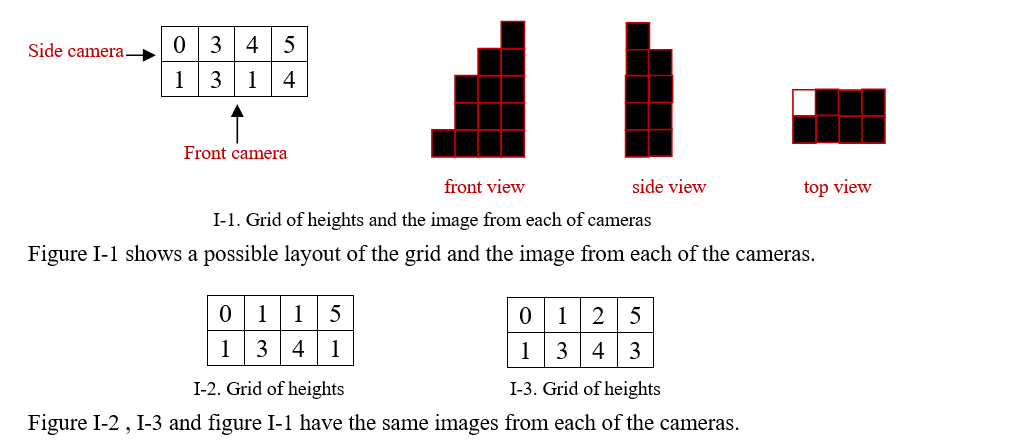
A theft gang noticed
this unmanned warehouse. They found that it took T seconds to transport a
crate. They wants to steal as many crates as possible. Since they cannot
disable the monitoring
system, they plans to fool it by arranging the remaining crates into piles so
that the next set of camera images are the same.
Is the remote online monitoring system safe?
If it's not safe, the maximum number of crates that can be stolen while
leaving a configuration of crates that will fool the monitoring system, camera images remain unchanged.
输入
The first line of the input contains
one integer T, which is the number of test cases (1<=T<=6). Each test case
specifies:
* Line 1: S T
(1<=S=1012 1<=T=103 )
* Line 2: m n
rows and columns in the grid, respectively. (1<=m, n<=100)
*Line 3..m+3: each
line contains n integers, the heights (in crates) of the piles in the corresponding row. ( all
heights are between 0 and 109 inclusive.)
输出
样例输入 Copy
3
10000  100
5  5
1  4  0  5  2
2  1  2  0  1
0  2  3  4  4
0  3  0  3  1
1  2  2  1  1
10000  100
2  3
50  20  3
20  10  3
1000  99
2  3
50  20  3
20  10  3
样例输出 Copy
9
30
10