OJ现已增加邮箱找回密码功能,还没有绑定邮箱的同学们请抓紧时间,以免密码丢失无法找回
题目描述
Jigsaw puzzle is a
popular intellectual game for its . It is not only used for education and
entertainment, but also for commercial advertising and political propaganda. Maps, animal landscapes, characters,
etc. can be made into jigsaw puzzles.
A salesman named
Dimma began to sell jigsaw puzzles. It first partitioned a map into several rectangular tiles, then disrupt the order. You need to rearrange it, spell out the
original map.
Suppose each fragment
is a rectangle of a*b , Dimma needs to cut
their printing costs by minimizing the number of rectangle used for their maps.
The left side of Figure J-1 shows 8 rectangles to cover a map. The right side shows how you can
cover the same map with only 6 rectangles.

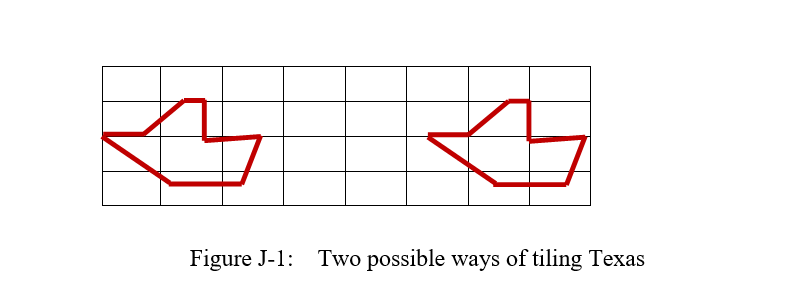
Your task is to help Dimma find the minimum number of rectangles needed to cover a given map. For simplicity, the map will
be given as a closed polygon that does not intersect itself.
Note that each fragment of map must be
part of a rectangular grid aligned with the x-axis and y-axis. That is, they touch each other
only with their whole sides and cannot be rotated. The polygon may touch the
edges of marginal lines . However, to
avoid floatingpoint issues, you may assume the optimal answer will not change
even if the polygon is allowed to go outside the map tiles by a distance of 10-6.
输入
* Line 1: n a b (3 ≤ n ≤ 50 1 ≤ a, b ≤ 100)
n is the number of polygon vertices , a
and b are the
dimensions of each rectangle.
*Line 2~ n+1: xi yi ( 0≤ xi≤ 10*a 0≤ yi≤ 10*b i=1…. n )
Each of the next n lines contains two integers xi nad yi
specifying the vertices of the polygon representing the region (in either
clockwise or counter-clockwise order).
输出
样例输入 Copy
12  9   9
1  8
1  16
6  16
9  29
19  31
23  24
30  23
29  18
20  12
22  8
14  0
14  8
样例输出 Copy
10